
This page provides factual clinical background about a class of licensed biologic medicine. It is not an advertisement and does not constitute a recommendation to seek any specific treatment. This page does not promote a prescription-only medicine to the public in accordance with Regulation 279 of the Human Medicines Regulations 2012. All treatment decisions must be made with a qualified clinician following individual assessment.
Reviewed by: Clinical team at the London Allergy & Immunology Centre |
Last reviewed: June 2026 |
Biological Treatment for Nasal Polyps and Atopic Dermatitis
Clinical Information — Prescription Biologic Therapy • London Allergy & Immunology Centre
The biologic therapy described on this page (an IL-4 receptor alpha inhibitor) is a prescription-only medicine (POM) in the United Kingdom. It cannot be obtained without a prescription from a registered medical practitioner. Full prescribing information is available in the
Summary of Product Characteristics (SmPC) on the Electronic Medicines Compendium.
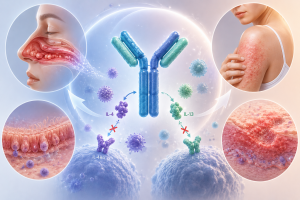
This treatment inhibits IL-4 and IL-13 signalling via IL-4Rα, reducing type 2 inflammation associated with chronic rhinosinusitis with nasal polyps and atopic dermatitis
Our London allergy consultants are specialists in a NICE-recommended biologic therapy that targets the underlying type 2 inflammatory pathway driving two related conditions: severe chronic rhinosinusitis with nasal polyps (CRSwNP) and moderate-to-severe atopic dermatitis (eczema). Where topical treatments, oral corticosteroids, or surgery have not provided adequate long-term disease control, this IL-4/IL-13 pathway inhibitor may represent a clinically appropriate next step — subject to full clinical assessment.
globally
regulatory approval
What Is This Biologic Treatment?
This treatment is a fully human monoclonal antibody that acts on the interleukin-4 receptor alpha (IL-4Rα) subunit, blocking the simultaneous signalling of both IL-4 and IL-13 — the two principal cytokines driving type 2 inflammation in the upper airway and skin. It is licensed in the United Kingdom by the MHRA for the following indications:
- Severe CRSwNP in adults aged 18 and over, as add-on therapy to intranasal corticosteroids when disease is inadequately controlled
- Moderate-to-severe atopic dermatitis in adults and adolescents aged 12 and over (and for certain regimens, children aged 6 months and older) where topical therapies have failed or are unsuitable
Mechanism of Action: Targeting Type 2 Inflammation
Both chronic rhinosinusitis with nasal polyps and atopic dermatitis share a common pathophysiological driver — dysregulation of the type 2 (T2) immune pathway. This anti-IL-4/IL-13 biologic works by binding to the IL-4Rα subunit, simultaneously blocking two key inflammatory cytokines:
By blocking both cytokines simultaneously via the shared IL-4Rα receptor, this biologic delivers a broad and sustained reduction in type 2 inflammation across the upper airway, lower airway, and skin — making it clinically relevant for patients with overlapping type 2 conditions such as asthma, CRSwNP, and eczema.1
Clinical Evidence and Current Guidelines
Nasal Polyps (CRSwNP)
The landmark Phase 3 SINUS-24 and SINUS-52 trials (Bachert et al., Lancet 2019) demonstrated statistically significant improvements in nasal polyp score, nasal congestion, and loss of the sense of smell compared with placebo, with clinically meaningful benefits observed as early as two weeks after starting treatment.1 Rates of revision surgery and systemic corticosteroid rescue were also significantly reduced.
In February 2026, NICE published Technology Appraisal TA1134, recommending this IL-4Rα inhibitor as an add-on treatment to intranasal corticosteroids for eligible adults with severe CRSwNP.2 Published NICE eligibility criteria include:
- Severe CRSwNP inadequately controlled with intranasal corticosteroids
- At least one prior sinus surgery
- A SNOT-22 symptom score of 50 or above at the start of treatment
- Treatment continuation assessed at 24 weeks using validated outcome measures
Atopic Dermatitis (Eczema)
The LIBERTY AD programme, including the pivotal CHRONOS trial (Blauvelt et al., Lancet 2017), established the efficacy of this anti-IL-4/IL-13 biologic in moderate-to-severe atopic dermatitis inadequately controlled by topical therapies. Significant reductions in itch and skin inflammation were demonstrated compared to placebo, with responses generally emerging within four to six weeks.3 Long-term extension data beyond three years continue to support a favourable benefit–risk profile.
NICE Technology Appraisal TA534 (2018) recommends this biologic for adults whose eczema has not responded adequately to at least one systemic therapy (such as ciclosporin, methotrexate, azathioprine, or mycophenolate mofetil), or where these are contraindicated or not tolerated.4 Response is assessed at 16 weeks using EASI and DLQI scores.
The 2025–2026 updated EuroGuiDerm guidelines (Wollenberg et al., JEADV 2025) and the UK STRIVE AD consensus (Luger et al., JEADV 2026) both provide a strong recommendation for this class of IL-4Rα inhibitor as the benchmark biologic for moderate-to-severe atopic dermatitis, reflecting an extensive safety record across age groups from 6 months upwards.5,6
Who May Be Suitable for This Treatment?
Following comprehensive clinical assessment, this biologic may be a consideration for patients with one or more of the following:
| ✓ | Severe nasal polyps not adequately controlled by intranasal corticosteroids or systemic steroids, or recurring after prior sinus surgery |
| ✓ | Moderate-to-severe eczema that has failed to respond to conventional systemic treatments, or where those treatments are contraindicated or not tolerated |
| ✓ | Co-existing type 2 conditions such as asthma, allergic rhinitis, food allergy, or eosinophilic oesophagitis — the shared IL-4/IL-13 pathway means improvements may be seen across multiple conditions simultaneously |
| ✓ | Frequent courses of oral steroids and a wish to reduce long-term corticosteroid exposure and its associated systemic risks |
| ✓ | Significant quality of life impairment including sleep disturbance, loss of sense of smell, facial pressure and pain, or chronic skin discomfort |
Safety Information
The following is a summary only. Always read the full Patient Information Leaflet and discuss your complete medical history, current medicines, and any concerns with your prescribing clinician before starting treatment. The complete safety profile, including rare and very rare adverse reactions and all contraindications, is available in the SmPC and Patient Information Leaflet.
Commonly reported adverse reactions
- Injection site reactions — redness, mild swelling, or discomfort; generally transient
- Conjunctivitis (eye irritation or inflammation) — more frequently reported in patients with atopic dermatitis; typically manageable
- Blepharitis (eyelid inflammation) — reported in some patients with atopic dermatitis
- Keratitis (corneal inflammation) — less common; report any eye pain or visual changes to your clinician promptly
- Oral herpes (cold sores) — reported at higher rates than placebo in some clinical trials
- Transient eosinophilia (temporary rise in white blood cell count) — generally clinically insignificant but monitored
- Headache — reported in clinical trials
Important safety considerations
- This biologic acts on a specific inflammatory pathway and does not broadly suppress the immune system. However, it should only be initiated and monitored by a suitably qualified specialist.
- Live vaccines must not be administered during treatment. Discuss your vaccination history with your clinician before starting.
- Inform your clinician of all medicines — including over-the-counter products and supplements — before starting this treatment.
- Use in pregnancy and breastfeeding: data are limited. Discuss the benefits and risks with your clinician if you are pregnant, planning a pregnancy, or breastfeeding.
- Report any new or worsening symptoms — particularly eye symptoms, skin infections, or allergic reactions — to your clinical team promptly.
Accessing This Treatment Through Our Clinic
This is a prescription-only biologic therapy that can only be initiated by a suitably qualified specialist following thorough individual clinical assessment. London Allergy & Immunology Centre is a private specialist clinic offering assessment and, where clinically appropriate following individual evaluation, initiation of biologic therapies. All treatment decisions are made by our consultants following your consultation.
What a Clinical Assessment Involves
|
1
|
Comprehensive Initial Assessment A detailed consultation with one of our allergy consultants, including full review of your medical history, symptom severity scoring (SNOT-22 for nasal symptoms; EASI and DLQI for eczema), and impact on quality of life. |
|
2
|
Investigations and MDT Review Depending on your presentation, this may include allergy testing (skin prick testing, specific IgE blood tests), spirometry, ENT assessment, or dermatology review. We operate a multidisciplinary approach with allergy, ENT, and dermatology consultants. |
|
3
|
Discussion of All Appropriate Options Your clinician will discuss all treatment options relevant to your diagnosis — this biologic therapy is one of several possible approaches. Alternatives, risks, and benefits will all be explained before any treatment decision is made. |
|
4
|
Treatment Initiation and Ongoing Monitoring If biologic therapy is dispensed by specialised pharmacy and initiated. A structured monitoring schedule using validated outcome measures. Direct access to our clinical team is available between appointments should any concerns arise. |
Frequently Asked Questions
Further Information and Resources
- Summary of Product Characteristics (SmPC) — Electronic Medicines Compendium
- Patient Information Leaflet (PIL) — Electronic Medicines Compendium
- NICE TA1134 — IL-4Rα inhibitor for severe CRSwNP (February 2026)
- NICE TA534 — Biologic therapy for moderate-to-severe atopic dermatitis (2018)
- MHRA Yellow Card — Report a suspected adverse reaction
- National Eczema Society — patient support and information
References
- Bachert C et al. Efficacy and safety of dupilumab in patients with severe chronic rhinosinusitis with nasal polyps (SINUS-24 and SINUS-52). Lancet. 2019;394(10209):1638–1650. doi:10.1016/S0140-6736(19)31881-1
- National Institute for Health and Care Excellence. Technology Appraisal TA1134: biologic therapy for treating severe chronic rhinosinusitis with nasal polyps. NICE; February 2026. nice.org.uk/guidance/ta1134
- Blauvelt A et al. Long-term management of moderate-to-severe atopic dermatitis with dupilumab and concomitant topical corticosteroids (LIBERTY AD CHRONOS). Lancet. 2017;389(10086):2287–2303. doi:10.1016/S0140-6736(17)31191-1
- National Institute for Health and Care Excellence. Technology Appraisal TA534: biologic therapy for treating moderate to severe atopic dermatitis. NICE; 2018. nice.org.uk/guidance/ta534
- Wollenberg A et al. EuroGuiDerm guideline on atopic eczema — updated recommendations including IL-4Rα inhibitor therapy across age groups. J Eur Acad Dermatol Venereol. 2025. doi:10.1111/jdv.20639
- Luger T et al. STRIVE AD: UK consensus statements for optimised management of atopic dermatitis. J Eur Acad Dermatol Venereol. 2026. doi:10.1111/jdv.20640
This page provides factual, educational information about a class of licensed prescription-only biologic medicine. It does not constitute an advertisement for a prescription-only medicine directed at the public as defined under Regulation 279 of the Human Medicines Regulations 2012, nor does it constitute medical advice. All treatment decisions must be made by a qualified clinician following individual assessment. Information is accurate to the best of our knowledge as of June 2026 and will be reviewed annually or sooner if significant changes occur. Our clinicians are registered with the General Medical Council (GMC).