
Allergy Testing in November: Plan Ahead for Hay Fever Immunotherapy
Posted: 15th November 2026 | Posted by: AdminMR
Allergy testing & treatment planning
By Professor Michael Rudenko
Consultant in Allergy and Immunology
London Allergy and Immunology Centre
November is a useful time to investigate hay fever and plan treatment before the next pollen season. Skin prick testing can identify sensitisation to relevant airborne allergens even when pollen levels are low. For suitable patients, an autumn assessment also allows time to discuss allergen immunotherapy, check suitability and arrange treatment before spring.
If hay fever affected your sleep, work, studies or enjoyment of the outdoors this year, you do not need to wait until symptoms return to seek advice.
Why consider allergy testing in November?
Hay fever, also called seasonal allergic rhinitis, occurs when the immune system reacts to pollen. Symptoms commonly include sneezing, an itchy or blocked nose, a runny nose and itchy, watering eyes.
Tree pollen typically causes problems in spring, while grass pollen is a major trigger in late spring and summer. The timing varies with the weather and where you live.1
By November, many people have a clearer picture of which months were difficult and which medicines helped. Reviewing this history alongside allergy tests can help distinguish pollen allergy from other causes of nasal symptoms.
Testing outside the pollen season is useful for planning; it is not inherently more accurate simply because it takes place in November.
If symptoms continue into winter, house dust mites, pets or moulds may be relevant. Persistent nasal symptoms can also have non-allergic causes, so a specialist assessment is more informative than a test result alone.
Can you have a hay fever test when you have no symptoms?
Yes. You do not need to be sneezing on the day of your appointment for skin prick testing to be useful.
The test checks for an immediate skin response to selected allergens. However, a positive result shows sensitisation: it does not automatically prove that an allergen causes your symptoms.
Professor Michael Rudenko interprets results alongside your symptom pattern, exposure history and response to treatment. Someone who tests positive to several pollens does not necessarily need immunotherapy for all of them.2
What is included in the airborne allergy testing panel?
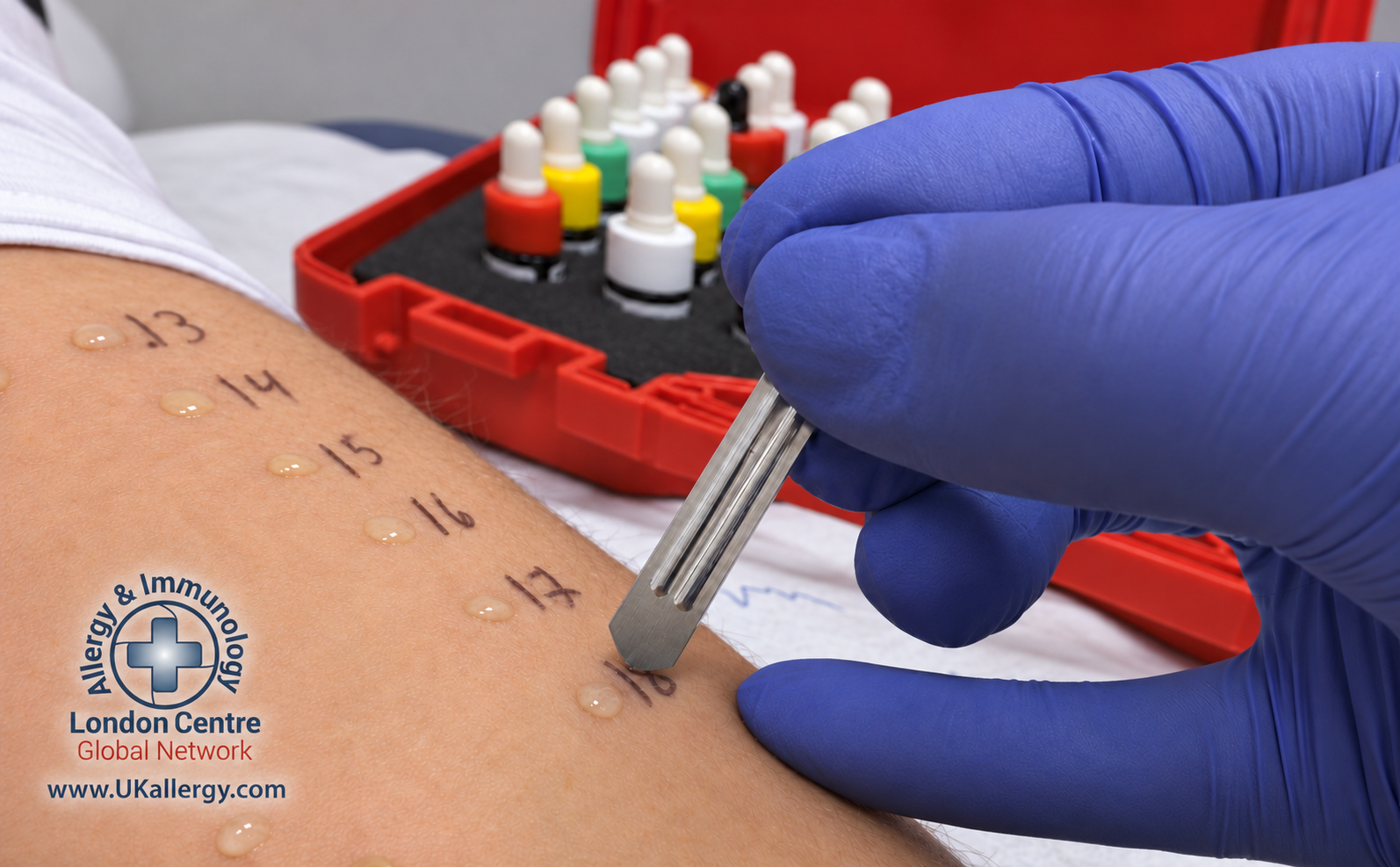
The airborne panel covers common inhaled allergens from pollens, house dust mites, animals and moulds. Your clinician will decide which tests are appropriate for your history.
| Allergen group | Allergens in the panel |
|---|---|
| House dust mites | Dermatophagoides pteronyssinus and Dermatophagoides farinae |
| Grass and cereal pollens | Grass mix; rye (Secale cereale) |
| Tree pollens | Oak; birch (Betula alba); ash/olive; plane |
| Weed pollens | Ragweed (Ambrosia elatior); mugwort (Artemisia vulgaris) |
| Moulds | Alternaria alternata; Aspergillus fumigatus; Cladosporium |
| Animal allergens | Cat; dog; horse |
The procedure also includes a positive control, usually histamine, and a negative control. These are checks on the validity of the skin test, rather than additional allergens. They help the clinician assess whether your skin responds as expected and whether non-specific skin reactivity affects interpretation.2
This is an airborne allergy panel. It does not assess every possible allergy, food intolerance or cause of a blocked nose.
What happens during skin prick testing?
Small drops of allergen extracts are placed on the skin, usually on the forearm. A small lancet gently pricks through each drop. The reactions are generally assessed after around 15–20 minutes.
A small, raised, itchy bump may develop at a positive test site. The clinician measures the response and compares it with the controls before explaining what it means for your symptoms.2
Where skin testing is unsuitable or difficult to interpret, allergen-specific IgE blood tests may be considered. Selected patients may benefit from component testing to clarify sensitisation or cross-reactivity.
Should I stop antihistamines before my allergy test?
Antihistamines can suppress skin prick test reactions and cause misleading negative results. Please check your specific medicine with the clinic before your appointment.
If the clinic confirms a two-day interval is appropriate for your antihistamine, stop it for at least 48 hours before testing. Some longer-acting antihistamines require a longer break, often around five days, so two days is not sufficient for every medicine.2
For a confirmed 48-hour interval, a Tuesday appointment means taking your last dose no later than the same time on Sunday; a Wednesday appointment means no later than the same time on Monday.
Tell the team about all medicines you take, including antihistamine-containing sleep aids or cold remedies. If stopping antihistamines causes significant symptoms, or you have taken a dose within the advised interval, contact the clinic for advice. An alternative testing approach may be appropriate.
Do not stop asthma inhalers or other prescribed treatment unless your treating clinician advises you to do so. Antihistamines do not usually need to be stopped for allergen-specific IgE blood testing.
Why plan hay fever immunotherapy before spring?
Allergen immunotherapy aims to reduce the immune system’s allergic response to a clinically relevant trigger. It works gradually and requires a planned course of treatment.
For seasonal sublingual immunotherapy, European guidance supports starting ahead of the relevant pollen season; the exact lead-in time depends on the product and prescribed regimen. Some regimens need several months of preparation.3
A November consultation leaves time to:
- Identify which allergens match your symptoms.
- Review previous medicines and nasal spray technique.
- Assess asthma control and other factors affecting suitability.
- Discuss the evidence, risks, treatment schedule and costs.
- Arrange any further tests and allow for treatment availability.
Planning early is particularly useful for tree pollen allergy because symptoms may begin before the main grass pollen season. A November assessment does not guarantee that every treatment can be supplied or started before the next season.
What does clinical research show about immunotherapy?
Clinical trials support allergen immunotherapy for appropriately selected patients with allergic rhinoconjunctivitis. The evidence must be considered for the specific allergen, product, dose and treatment schedule.3
A randomised grass pollen immunotherapy trial found that benefits persisted during two years of follow-up after a three-year treatment course. This supports the possibility of a lasting effect, but the findings should not be assumed to apply to every liquid spray or allergen mixture.4
Research published in 2025 also supports particular liquid sublingual formulations. One systematic review included 25 randomised trials involving 1,830 patients in its symptom-score analysis and found improvements compared with placebo. A separate review of a five-grass liquid formulation also found reductions in symptoms and medication use.5,6
These findings do not mean that every patient will respond equally or that all immunotherapy preparations are interchangeable. A course of at least three years is generally recommended when aiming for sustained benefit, subject to the prescribed regimen and clinical review.3
Who might benefit from a hay fever immunotherapy assessment?
An assessment may be helpful if you have confirmed pollen allergy and symptoms remain troublesome despite appropriate treatment, particularly when hay fever affects sleep, concentration, work or school.
At London Allergy and Immunology Centre, suitable patients can discuss sublingual spray immunotherapy, given under the tongue. Treatment selection follows an individual assessment.
Mouth or throat irritation can occur, especially early in treatment. Serious allergic reactions are possible. Asthma must be assessed and adequately controlled, and the specialist will review relevant medical conditions, medicines and product precautions before prescribing.
Immunotherapy is not a guaranteed cure. You may still need antihistamines, nasal sprays or eye drops, particularly during the early stages of treatment or periods of high pollen exposure.
Read more about hay fever testing and sublingual immunotherapy.
Book an allergy testing appointment on Tuesday or Wednesday
Book a Tuesday or Wednesday allergy testing clinic appointment at London Allergy and Immunology Centre to investigate relevant airborne triggers and discuss planning for the next hay fever season. Appointments are subject to availability.
Bring a list of your medicines, any previous allergy results and a brief record of when your symptoms occur. When booking, tell the team if you still take antihistamines so they can confirm the correct stopping interval before skin prick testing.
Book an allergy testing appointment or contact the team on 020 3143 3449 or info@ukallergy.com.
Frequently asked questions
Is November too early to prepare for hay fever?
No. November provides time for assessment, testing and treatment planning before spring. The appropriate immunotherapy start date depends on the allergen and product.
Does a positive allergy test mean I need immunotherapy?
No. Treatment depends on whether the result matches your symptoms, how much those symptoms affect you and how well other treatments work.
Can house dust mites cause symptoms in November?
Yes. House dust mite allergy can cause symptoms throughout the year. A consultation can help determine whether mites or another trigger are relevant.
Can I have testing if I cannot stop antihistamines?
Contact the clinic before attending. Allergen-specific IgE blood testing may be an option because antihistamines do not usually interfere with it.
Will immunotherapy work before the next pollen season?
Some patients experience improvement during their first treated season, but benefit varies. Timing, adherence and the specific preparation matter; treatment is a longer-term commitment.
This article provides general information and does not replace individual medical advice.
Research and guidance
- Met Office. When is hay fever season in the UK?
- BSACI. Adult Skin Prick Testing Standard Operating Procedure, 2021.
- Roberts G et al. EAACI Guidelines on Allergen Immunotherapy: Allergic rhinoconjunctivitis. Allergy. 2018;73:765–798.
- Durham SR et al. SQ-standardized sublingual grass immunotherapy: confirmation of disease modification two years after three years of treatment in a randomised trial. Journal of Allergy and Clinical Immunology. 2012;129:717–725.e5.
- Di Bona D et al. Efficacy of index of reactivity-liquid sublingual immunotherapy in allergic rhinoconjunctivitis: a systematic review and meta-analysis of randomised studies. Frontiers in Allergy. 2025;6:1597003.
- Di Bona D et al. Efficacy of five-grass pollen liquid sublingual allergen immunotherapy for seasonal allergic rhinoconjunctivitis: a systematic review and meta-analysis. Journal of Investigational Allergology and Clinical Immunology. 2025;35:341–352.