
MRGPRX2 and Mast Cells: Allergy Research Explained
Posted: 9th September 2026 | Posted by: AdminMR
Allergy and immunology research update
MRGPRX2 and mast cells: a new pathway in allergy research
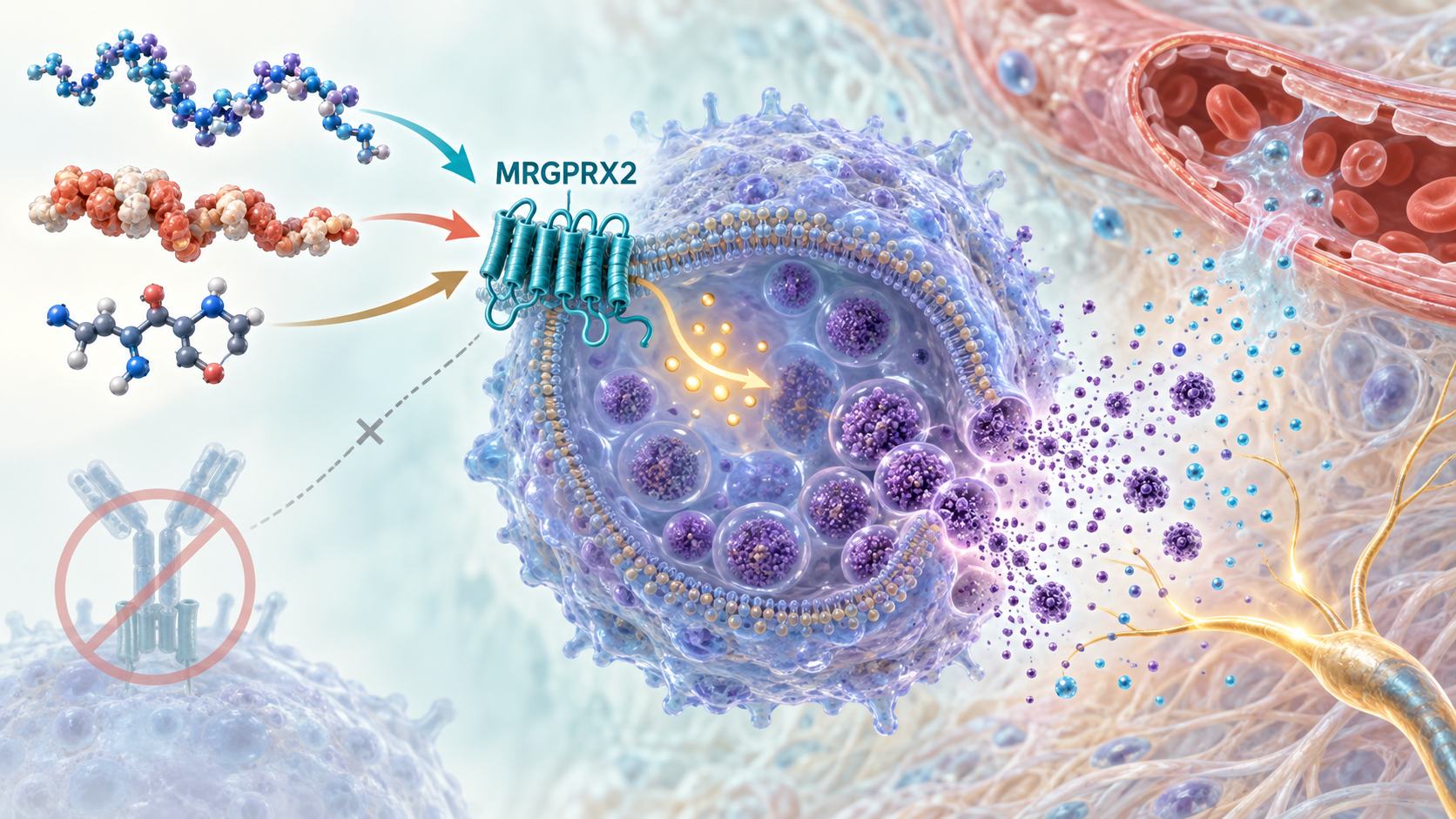
MRGPRX2 helps certain mast cells respond without the conventional immunoglobulin E pathway. It may explain some immediate drug reactions and could contribute to itch, hives and inflammatory skin disease — but it is not yet a routine diagnostic marker or an approved treatment target.
Key message:
MRGPRX2 is an important research pathway, particularly for selected non-IgE-mediated drug reactions. Evidence in chronic urticaria and atopic dermatitis suggests biological activity in some patients, but controlled trials reported up to September 2026 have not established an effective MRGPRX2-targeted treatment for these conditions.
Established biology
MRGPRX2 can activate human mast cells independently of allergen-specific IgE.
Strongest clinical link
Selected immediate reactions to cationic medicines, although individual diagnosis remains difficult.
Still investigational
Its role in eczema, chronic hives and inflammatory bowel disease is not yet treatment-defining.
On this page
What is MRGPRX2?
Mas-related G protein-coupled receptor X2, usually shortened to MRGPRX2, is a receptor found at particularly high levels on a type of immune cell called the mast cell. It is especially associated with connective-tissue mast cells in the skin and around blood vessels and nerves.
Mast cells contain granules filled with active substances such as histamine, tryptase and other inflammatory mediators. When appropriately activated, they release these substances in a process called degranulation. This can produce redness, swelling, itching, wheals, flushing and, in more serious reactions, broader systemic symptoms.
The best-known route to mast-cell activation involves allergen-specific immunoglobulin E, or IgE. MRGPRX2 is important because it offers a different route. It can recognise a structurally varied group of positively charged molecules, including certain neuropeptides, host-defence peptides, microbial signalling products and selected medicines. This allows a mast cell to respond rapidly even when allergen-specific IgE is not involved.
A simple way to picture it
IgE is like a highly specific key made after sensitisation. MRGPRX2 acts more like a rapid danger sensor that can respond to several unrelated signals. Both pathways can activate mast cells, and the resulting symptoms may look similar.
MRGPRX2 activation and conventional IgE-mediated allergy
The distinction matters because two reactions that look alike may arise through different mechanisms. However, symptoms alone cannot reliably identify the pathway involved.
| Feature | IgE-mediated activation | MRGPRX2-mediated activation |
|---|---|---|
| Usual trigger | A specific allergen recognised by IgE | Selected peptides, microbial signals or cationic medicines |
| Prior sensitisation | Usually required | Not necessarily required |
| Possible symptoms | Itch, wheals, swelling, breathing or systemic symptoms | Can look very similar clinically |
| Routine confirmation | Clinical history supported, where appropriate, by validated testing | No validated routine receptor-specific diagnostic test |
Important: A suspected medicine reaction should not be labelled as an MRGPRX2 reaction simply because the medicine can activate this receptor in a laboratory. Concentration, route, timing, other medicines and alternative mechanisms all matter. An allergist must interpret the full clinical history.
Which conditions are linked to MRGPRX2?
Immediate drug hypersensitivity
This is the clearest clinical setting for the pathway. Laboratory studies show that selected medicines can activate MRGPRX2-positive human mast cells. Examples investigated include some neuromuscular blocking agents, fluoroquinolone antibiotics and opioid medicines.
What remains uncertain: not every reaction to these medicines is caused by MRGPRX2, and IgE-mediated reactions can still occur.
Chronic urticaria
Studies of skin challenge, circulating markers and a 2025 genetic variant suggest that MRGPRX2 activity may be greater in a subgroup of people with chronic spontaneous urticaria.
What remains uncertain: no validated test identifies an MRGPRX2-dependent subgroup, and a 2026 phase 2b trial in unselected CSU did not meet its primary endpoint.
Atopic dermatitis
MRGPRX2 could connect mast cells, inflammatory peptides, sensory nerves and the itch-scratch cycle. Human skin findings and disease models support a possible amplifier role.
What remains uncertain: a small randomised 2026 study of EP262 showed no meaningful improvement over placebo in biological or exploratory clinical measures.
Inflammatory bowel disease
Human tissue work has linked MRGPRX2-positive mast cells with active inflammatory bowel disease, including findings reported in 2026 in people with hereditary alpha-tryptasaemia.
What remains uncertain: association does not prove causation, animal studies show context-dependent effects, and there is no established MRGPRX2-directed IBD treatment.
What did the 2026 research add?
Research available by September 2026 gives a more measured picture than laboratory biology alone. It shows why controlled human studies are essential.
Randomised atopic dermatitis study
EP262 was well tolerated, but did not show meaningful benefit over placebo
In the EASE study, 32 adults were randomised 2:1 to EP262 or placebo for six weeks. The primary purpose was safety and tolerability. The investigators reported no meaningful between-group differences in gene expression, skin thickness, Eczema Area and Severity Index, investigator assessment or peak itch scores. The study was small and short, but it did not provide clinical proof that MRGPRX2 blockade improves unselected atopic dermatitis.
Randomised chronic spontaneous urticaria study
EVO756 did not meet the primary CSU endpoint
Sponsor-reported top-line results from a 160-person phase 2b trial showed that none of three EVO756 dose regimens separated from placebo for change in the seven-day Urticaria Activity Score at week 12. These results are stronger evidence than earlier open-label activity in chronic inducible urticaria, although full peer-reviewed trial reporting is still needed.
Human gastrointestinal tissue
MRGPRX2-positive mast cells were increased in a defined IBD setting
A 2026 publication reported increased MRGPRX2-expressing mast cells and activation markers in gastrointestinal samples from people with active IBD and hereditary alpha-tryptasaemia. This is valuable human tissue evidence, but it remains an association in a particular population rather than proof that blocking the receptor will improve IBD.
The interpretation
A pathway may be active without being the main driver
MRGPRX2 may still matter in carefully selected patients, tissues or disease stages. However, negative controlled studies caution against assuming that all mast-cell-associated disease is MRGPRX2-dependent. Future trials need better biomarkers, evidence that a medicine reaches and inhibits the receptor in the relevant tissue, and prospective selection of biologically appropriate patient groups.
What does MRGPRX2 mean for patients now?
MRGPRX2 is not currently a diagnosis. There is no validated routine blood test, skin test or genetic test that can confirm that a person’s symptoms are caused by this receptor. There is also no approved MRGPRX2-directed treatment as of September 2026.
For clinical care, a careful history remains central. An allergy assessment may consider the suspected trigger, dose, route, timing, previous exposure, other medicines, objective symptoms, treatment required and recovery. Depending on the situation, the consultant may consider validated allergy tests or a carefully supervised challenge. Not every patient requires every investigation.
If you had a suspected drug reaction
Record the medicine, dose, route, timing, symptoms, photographs if available, other medicines and treatment received. Do not deliberately take the suspected medicine again without medical advice.
If you have chronic hives or eczema
Treatment should remain based on an established diagnosis and current clinical guidance. MRGPRX2 testing is not presently part of routine treatment selection.
If you are considering a clinical trial
Ask what is known about the medicine, the trial phase, target-engagement evidence, possible risks, alternatives and what happens when the study ends.
Concerned about a medicine reaction, recurrent hives or unexplained swelling?
A consultant-led allergy assessment can help distinguish established diagnoses from emerging research hypotheses and identify appropriate investigations and treatment.
Frequently asked questions about MRGPRX2
Is MRGPRX2 the same as an allergy?
No. It is a receptor and a route through which certain mast cells can be activated. Some reactions produced through this route can resemble an immediate allergy, but the underlying mechanism is different from classical allergen-specific IgE activation.
Can I be tested for MRGPRX2?
Research assays exist, but there is currently no validated routine clinical test that can show that an individual reaction or chronic condition is driven by MRGPRX2. Commercial or research results should not be interpreted without specialist context.
Does a negative IgE test prove an MRGPRX2 reaction?
No. A negative IgE result does not identify the alternative mechanism. Test limitations, timing, the suspected medicine and other non-IgE pathways must all be considered.
Are MRGPRX2-blocking medicines available?
No MRGPRX2-directed medicine is approved for routine clinical care as of September 2026. Several compounds have entered early clinical development, but efficacy has not yet been established.
Could MRGPRX2 explain all chronic urticaria?
Current evidence says no. Chronic spontaneous urticaria is heterogeneous and can involve autoallergy, autoimmune mechanisms and other mast-cell-activating pathways. MRGPRX2 may be relevant to a subgroup, but that subgroup cannot yet be reliably identified in routine practice.
Selected medical literature
The following sources include foundational studies, prominent peer-reviewed publications and important 2025–2026 updates. Company-reported clinical results are identified separately.
- McNeil BD and colleagues. Identification of a mast-cell-specific receptor crucial for pseudo-allergic drug reactions. Nature. 2015;519:237–241. doi:10.1038/nature14022
- Roy S and colleagues. Multifaceted MRGPRX2: new insight into the role of mast cells in health and disease. Journal of Allergy and Clinical Immunology. 2021;148:293–308. PubMed
- Elst J and colleagues. Novel insights on MRGPRX2-mediated hypersensitivity to neuromuscular blocking agents and fluoroquinolones. Frontiers in Immunology. 2021;12:668962. PubMed
- Cao C and colleagues. Structure, function and pharmacology of human itch GPCRs. Nature. 2021;600:170–175. doi:10.1038/s41586-021-04126-6
- Jia T and colleagues. Mast cells initiate type 2 inflammation through tryptase released by MRGPRX2/MRGPRB2 activation in atopic dermatitis. Journal of Investigative Dermatology. 2024;144:53–62.e2. doi:10.1016/j.jid.2023.06.201
- Ye D and colleagues. MRGPRX2 gain-of-function mutation drives enhanced mast cell reactivity in chronic spontaneous urticaria. Journal of Allergy and Clinical Immunology. 2025;156:159–170. PubMed
- Cuc NTK and colleagues. Serum MRGPRX2 and substance P levels are biomarkers of disease activity rather than antihistamine response in chronic spontaneous urticaria. Scientific Reports. 2025;15:10014. doi:10.1038/s41598-025-94841-1
- Galeas-Pena M and colleagues. MRGPRX2-expressing mast cells are increased in the gastrointestinal tract of individuals with active inflammatory bowel disease and hereditary alpha-tryptasaemia. Frontiers in Allergy. Published 2026. PubMed
- Dehn S and colleagues. EP262, an MRGPRX2 antagonist for the treatment of atopic dermatitis: results from the phase 2 randomised EASE study. Dermatology and Therapy. Published online 21 August 2026. PubMed
- Evommune. Top-line results from the EVO756 phase 2b trial in moderate-to-severe chronic spontaneous urticaria. 29 June 2026. Sponsor report; full peer-reviewed results were not available at the review date. View source
Medical disclaimer: This page provides general educational information and does not diagnose a condition or replace an individual medical assessment. Research concerning MRGPRX2 is evolving. If you develop breathing difficulty, collapse, rapidly progressive swelling or other features of a severe immediate reaction, seek emergency medical assistance.
Content reviewed against medical literature available up to September 2026.